|
10 Colourful
Erotic Shunga Scenes Portraying Tattooed Protagonists.
A lot of Japanese artists designed erotic
prints (shunga). Apart from explicit depictions of sexual activities, shunga
may contain several layers of meaning including all kinds of hidden messages
which requires an experienced eye and a thorough knowledge of Japanese
literature, poetry and historical past.
The characters depicted in shunga represent the
whole spectrum of Japan's society. Its cast exists from nobleman to farmers,
from excited housewives to high-class courtesans, from foreigners to monks,
from warriors to kabuki actors, but also the tattooed members of the
working-class participated in this esoteric community. The following 10 are
some colourful examples:
|
| Flying
Geese - Utagawa Kunisada
|
 |
This
plate comes from an costly erotic picture book, a three-volume work
called Prospects for the Four Seasons, which probably was
commisioned by a wealthy merchant. A couple is involved in a vigorous
love-making session. On his back the man sports a tattoo of one of the
Suikoden heroes.
On the wall behind them two woodblock prints
have been pasted, with one of them portraying the well-known kabuki
actor Matsumoto Koshiro V.
The couple seems to be distracted by the
noise of the flying geese which can be seen through the window.
|
|

|
In the Bedroom - Utagawa Kuniyoshi
|
| A shunga scene designed by the great Kuniyoshi
in a similar composition as the previous print by Kunisada. The woman is
partly covered by her blue kimono with gourd plants decorations. The man is
almost naked except for the red loincloth. On his back he has a very detailed
tattoo, showing the poetess Ono no Komachi , who was one of Japan's six
immortal poets. The depicted scene of the tattoo comes from an episode in
Komachi's legendary life known as the Praying for Rain Komachi. The
title of Kuniyoshi's shungabook is called The Female Treasure Ship and
was published in 1853. In this image the distraction of their passionate
encounter is intentionally unclear.
|
| Sashichi and Koito - Utagawa School
The sisters Ofusa and Koito, were two
well-known protagonists from Japanese classical literature and music. In this
tale they are involved in a love-triangle with the tattooed dandy Sashichi who
was Ofusa's husband. A design (c1850s) in the small koban format with strongly
visible embossing.
|
 |
|

|
Crowded Pleasure-Quarter - Yanagawa Shigenobu
From
> Shigenobu's Floating Bridge of
Heaven
(1830) a scene taking the viewer to the crowded quarters of clandestine
brothels. In these kind of occasions there was no privacy and almost no room
for prostitutes and their clients, at best they were divided by a sliding door
or folding screen.
|
|
Four Seasons - Utagawa Kunisada
Another design (see first print!) from
> Kunisada's
Four Seasons series with a courtesan and her tattooed client. The man is penetrating the
woman while using his thumb to stimulate the woman's clitoris. It's like the
mosquito-net above them has been pulled up for the beholder to get a better
view. The series was published late 1820s.
|
 |
|
 |
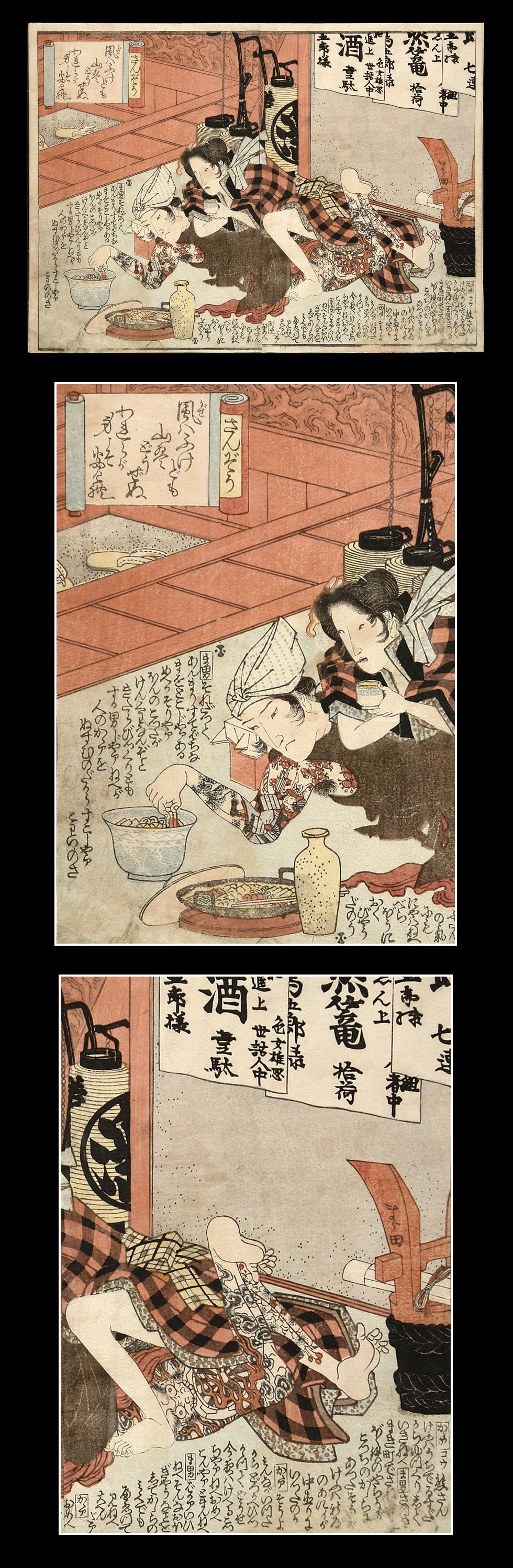
Eating - Utagawa Toyokuni I
An almost completely tattooed man (except for
his face) is having intercourse with his woman and is eating from a bowl at
the same time. The woman is holding a cup of sake while keeping a hairpin in
her mouth. Their sexual activities seem to be of minor importance.
|
| Mosquito Net - Utagawa Kunisada
An intimate couple is violently disturbed by a
tattooed intruder.
The invader is holding the husband underneath the
mosquito-net while grapping the woman's kimono who's trying to flee. A famous
image from Kunisada's The Eight Dog Heroes of the Satomi Clan
(1837).
Here you can find this
> famous Kunisada
shunga print.
|

|
|
 |
Suikoden Warrior - Kuniyoshi School
In this parodic scene (c.1840s) on Kuniyoshi's
celebrated Suikoden series the Suikoden hero Kyumonryo Shishin
(Chinese name: Shi Jin) takes a woman from behind while using his inseperable
pole as an accessory.
For more info on >
Kuniyoshi's Suikoden
series.
|
|
Praying - Takeda Hideo
A silkscreen print design by Takeda Hideo
(1948-present) displaying a pointed-headed man, tattooed with an atrocious shishi
(guardian lions in Ancient China) heads and peony flowers, devotedly praying
with the woman kneeling in a tempting pose. She's tattooed from her back to
her heels with spectacular depictions of a blueish green Fudo ('The
Immovable') surrounded by flames, dragons, carps set against a blue
background. The print is entitled Praying to Fudo Myo-o from the series
Monmon (a term used for tattoo in Osaka) and was made in 1976.
|
 |
|
Takeda Hideo is a modern Japanese print artist
who designed a large quantity of prints dominated by tattoos. He likes to call
himself a cartoonist but with his distinguishing and original series, Genpei
and Monmom, depicting tattooed warriors and colourful, sometimes
erotic, cartoons, he has been embraced by a worldwide audience.
|
|

|
Tribute to Utamaro - Paul Binnie
A contemporary erotic print by the young
Scottish artist Paul Binnie (1967-present) with a young completely naked girl
sitting on a wet wooden table looking at the beholder in a tempting pose. On
her back a tattoo of a shunga design by the great Japanese artist Kitagawa
Utamaro from his acclaimed oban series Picture Book: Pulling Komachi (Ehon
Komachi-biki) published in 1802. Binnie's print is entitled Utamaro no
shunga (Utamaro's Erotica) from the series A Hundred Shades of Ink of
Edo (Edo sumi hyaku shoku) published in 2005. The artist's red seal in the
lower left corner, reading Binnie, is made into the shape of a butterfly,
referring to Puccini's opera 'Madame Butterfly', where the heroine is
taken unwittingly as a 'temporary' wife.
There's another version (2009)
of this design without the tattoo.
|
|
Some
of the prints treated in this article are available in
>> our
gallery If you are a shunga
lover or collector please don’t hesitate to contact us if you have
any questions/inquiries on the items we are offering: >>
e-mail. |
|