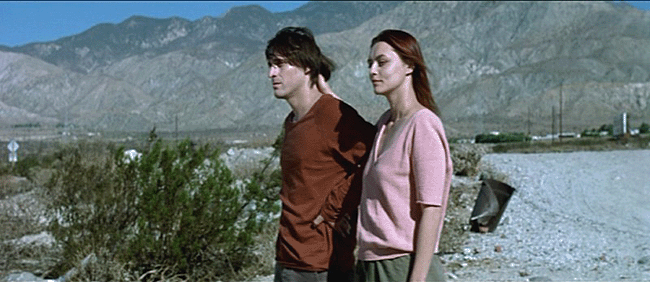
|
Bruno Dumont's Pessimistic
World-View in His Movie Twentynine Palms.
The >
movie
Twentynine Palms (2003) is the third feature-length movie of the
remarkable French director-philosopher-visual artist >
Bruno
Dumont.
Only in
France, one is often tempted to think, movie directors can work on a steady
development of a wayward oeuvre. Only in France, there seems to exist a movie
culture, supported by a large, frequently visiting audience, with a sufficient
amount of interest and ability to bear an explicit artistic cinema. This is
especially true for the still small (up to now 5 movies), but consistent and
distinguishly personal featured body of work of Bruno Dumont. His cynical
movies, don't bother to please the public.
 |
So, what is it that makes Dumont's work so
fascinating? It is especially his vision and eye for detail concerning human
behavior. The environment in all his movies, in which the events take place
are all desolate places, like the countryside or like in his movie Twentynine
Palms , a desert. These kind of places offer the possibility to portray
his protagonists in an isolated situation, disconcerted from disturbing
factors, so that he can examine their interaction intensively. The countryside
fuctions like a laboratory in which the characters have the space to
demonstrate their reactions on each other. The character as an experimental
animal; in that sense Dumont's movies are truly experimental.
Also in his movie Twentynine Palms, the
protagonists have all the space, the area of Twentynine Palms spans 800,000
acres, but even here it seems impossible to escape homo homini lupus est
('man is a wolf to his fellow man'). This park, the location of the film, is
an endlessly barren and abandoned mountainous landscape, in which only yuca's
flourish, and windmills. A real wilderness, that in Dumont's vision can be
interpreted as a correlate of the wasteland in human relationships.
|
|
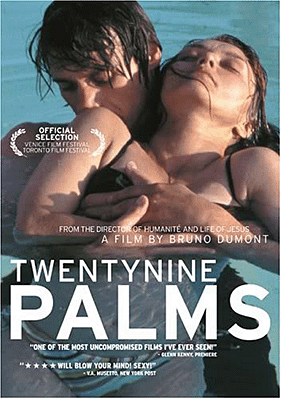
Film affiche for the >
movie ' Twentynine
Palms`
|
|
 |
|
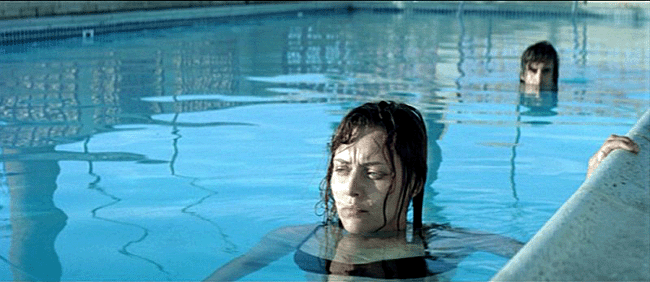
Katja Golubeva and David Wissak
|
With the movie
Twentynine Palms , Dumont enters another, less familiar surroundings than
the Northern-French countryside of his first two movies
> La Vie de Jésus (Life
of Jesus) (1997) and
> L'Humanité
(Humanity) (1999)
in which the protagonists are grounded in their geographical and
social surroundings. The characters in Twentynine Palms seem to be set
out in an environment that doesn't seem to be hostile at first, but impersonal
and indifferent. Strange is also the relation between the two protagonists
themselves, he is a photographer looking for a location, she travels with him.
They don't seem to have a previous history together. To this lack of
familiarity, Dumont also added another layer, by giving his actors very
minimal directions, pushing them to an exasperation point.
The fact, that the characters bare the same
name as the actors themselves -- David (David Wissak, an unknown actor, at
that time he only had a credit as a voice actor in a Disney animation) and
Katja (Katja Golubeva, known as an actress in the movies of the Lithuanian
director Sharunas Bartas) -- is indicative for the wafer-thin fictitious
layer. Besides this they (as actors!) have a different mother tongue and have
to comunicate through pidgins, broken French and English. Consequently, the
actors, like their characters have little in common.
As the story (rather a series of non-linear
events) of the movie unfolds, the beholder learns near to nothing about the
characters. They don't tell each other stories, don't dish up memories and
don't fantasize about the future. They live in the here and now. In the rather
explicit sex scenes it's like you're watching a nature documentary, this is
not love-making, but pairing.
The events in the movie Twentynine Palms
are not easy linked together. They travel in a SUV, stay in a motel, and
explore locations to photograph.
It's only in retrospect that certain elements
seem to have a different context and pattern. For example, when they arrive at
a motel in Twentynine palms they relax in a swimming pool, in the background
police sirenes can be heard. Later when they are walking in the village, a
motorist shouts a curse at them, adding that it is his street. Therefore every
following car becomes a possible threat, but it is only after the gruelling
final part of the movie that all these small incidents seem to have a
different meaning.
"I am interested in the shock",
Dumont explained in an interview after the premiere of his movie Twentynine
Palms. "...In generating a primary reaction with the public. And
because you have to show the visible to bring about the invisible, I show
horrible things. I show people the opposite of what they want or expect to
see. This contrast forms the power of cinema: movies have to show evil to
accomplish that people will do good".
|