The Enigmatic Ukiyo-e
Woodblock Print Genius Sharaku.
Tōshūsai Sharaku's (act. 1794~95) rise to fame in the world of Ukiyo-e ('Floating World') was sudden
and very short leaving a distinguishing and unique body of work. He made his
debut in 1794 with 28 okubi-e (large close-up portraits) of famous kabuki
-actors. These prints were published by Tsuya Juzaburo (1750 ~1797) who
also introduced > Utamaro
(1753~1806) into the world with his okubi-e
masterpieces of bijin (beautiful woman). Juzaburo published
Sharaku's prints with kirazuri (technique in which mica powder was
applied to the surface of the print) or mica printing (a method of
printing in which a silver colored effect was obtained by bringing mica powder
to the background). This impressionistic rendering of actors by Sharaku,
whereby their facial expressions during their acting were strongly
exaggerated, was a sensation causing positive as well as negative reactions.
Some additional background information has to be
provided about the circumstances under which these actor prints were
published. At the time Tsuya Juzaburo was being punished, because of
infringing the censorship regulations, by the government (the Tokugawa
shogunate). For a period of time he was not allowed to publish any print and
also half of his possessions were confiscated. To make ends meet he formed a
scheme by publishing actor prints designed by a complety unknown artist,
namely Sharaku. Moreover, during this period three of the biggest theatres in
Edo (nowadays Tokyo) had been closed because of debts and the strict
supervision on the observance of the instructions. Therefore the kabuki -loving
audience was forced to watch the performances in small theatres. It was a slow
and somewhat boring time. In such a time the daring individual close-up
portraits of actors by Sharaku must have made a very refreshing impression on
the public.
|

|
The
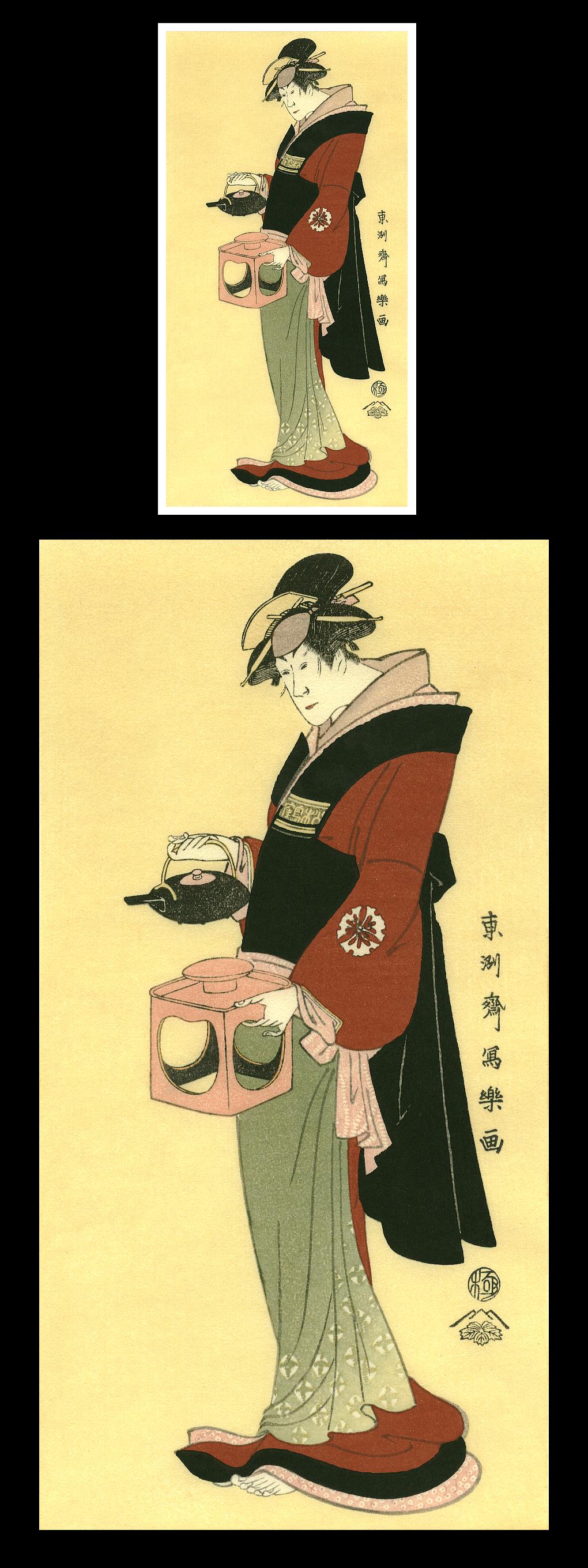
actor Matsumoto Yonesabro in the role of a tea-house servant , c.1795 .
|
Before Sharaku there were also okubi-e of
actors published, like the designs of Shunko (1743~1812), but they had a
milder expression.
The publication of the works by an unknown artist executed
so magnificently including such a forceable expression surprised the people.
Sharaku's portraits were unusual because he not only portrayed top-actors but
also had an eye for the second-rate artists. These were extravagant kirazuri
-portraits, while at the same time a minimal amount of colors was used
exhibiting a passionate desire to translate the role of the actor and the
atmosphere on stage.
In the second period of Sharaku's short career
he produced full-length portraits of 1 or 2 persons and in the third and final
period he specialized in the hosoban (narrow print) and aiban (middle-sized
print) format sometimes depicting sumo wrestlers. The power of his pencil
declined in a fast pace losing its initial display of inspiration.
The mysterious Sharaku designed 140
woodblock prints in merely 10 months and then suddenly vanished. The
evaluation of his work fluctuated over the years. Although all critics agreed
on its uniqueness the real appreceation came at the end of the 19th Century
when the European impressionists embraced the art of Ukiyo-e. There are
various theories about the identity of Sharaku. Some say he was not an
illustrator by profession but an actor in Noh plays.
Others say that
the name Sharaku was a pseudonym of the famous artist >
Katsushika Hokusai
(1760~1849) who had a hiatus of 5 years (between 1790~1795) in his career.
Most of the Ukiyo-e artists who lived and worked
in Edo only left the artwork they produced leaving researchers groping in the
dark about their lifes and career. Sharaku being such an artist is so
appealing because he produced a large amount of unique work in a very short
time period. After Sharaku's dissapearance his publisher Juzaburo introduced
several gifted artists and died two years later without leaving any
explanation on Sharaku.