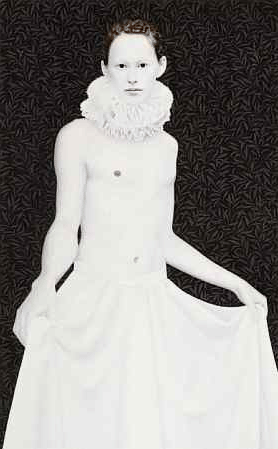
Queen Elizabeth
A major influence on Van Drongelen's "style" is the Victorian
photography of the 19th C. and in particular the work of the British
autodidact Julia Margaret Cameron (1815-1879). At the time of
Victorian photography models had to sit still in a pose for 20 minutes for a
successful photo. This resulted in strikingly "empty" expressions
because the muscles of their faces were sagged during their pose. A similar
effect can be found in the portrait paintings of the early Renaissance in
which the human figures, because of the lack of technique, often looked
hollow-eyed and soulless.
Although certain elements in Van Drongelen's portraits are reminiscent to
the Renaissance-era (the lace collar for instance), they are at the same
time very distinguishing because of Van Drongelen's skilful way of
transforming the reality to his will.
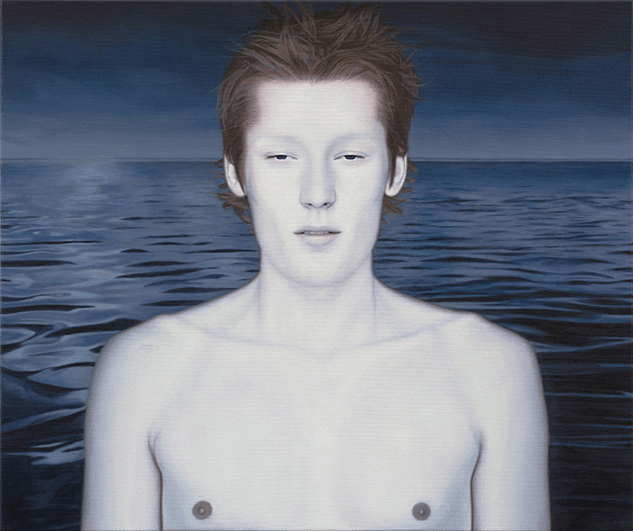
His choice to depict the figures in his paintings in an almost white skin
tone is inspired by the portrait paintings that were made of Elizabeth I.
When the British needed an emperor, who had to be presented as a deity above
the people, Queen Elizabeth decided to put white face makeup on and was only
portrayed in this manner.
Buddha
On average, Van Drongelen works for three months on a painting. After a
detailed building up he partially overpaints details with transparent layers
resulting in a pale but mostly thin, white and fragile skin. He doesn't work
within the Western painting tradition using a narrative perspective to
communicate a message or view. He rather tries to capture a mental or
emotional experience: "Just addressing to stories about these
experiences don't measure up to the total experience".
A character with an open expression seems to reveal everything but you
(as the beholder) can not grap what is exposed, you are only a witness of
the fact that the character opens himself. Van Drongelen:
"Vulnerability implies power, nothing implies everything". When
the beholder is confronted with a created vacuum he will project
associations on this vacuum, like a Buddha statue with a neutral expression
also invites the beholder to reflect his emotions. His intention is to seek
a representation of an empty symbolism or a multitude against an emptiness.
Dedication
Due to his increasing knowledge of technique and anatomy Van Drongelen's
fascination has not only expanded from the face to the rest of the body
parts but also on the emphasis on the external visual elements and the
actual background. His dedicated and meticulous working process (he destroys
previous versions of the final painting) combined with his eloquent craftmanship
makes him an artist to keep an eye on in the future.
|
|
| No
Title, 2011, oil on canvas, 33 1/5" x 37 2/5"
|