"In all of us, even in good men, there is
a lawless wild-beast nature, which peers out in sleep". This quotation by
the Greek philosopher Socrates especially applies to the work of the Dutch
painter >
Ronald Ophuis
(1968, The
Netherlands, Hengelo). His large canvases (sometimes even 8ft. x 17ft.)
portray disturbing images of sex and violence in a gloomy scenery that makes a
penetrating and lasting impression on the viewer.
Influence
Ronald Ophuis grew up in Hengelo (in the
Eastern part of the Netherlands). Although he drew from an early age he had no
specific ideas about it. The great eye opener about being an artist came after
seeing a documentary on the painter and sculptor Markus Lüpertz (1941,
Germany, Reichenberg). Ophuis studied at the Rietveld Academy in Amsterdam and
the Academy of Visual Arts in Enschede. A major influence on his painting
style became Lucian Freud (1922, Germany, Berlin) like him he uses tertiary
colors and with the figures portrayed in an agressive realistic manner.
He was 3 years old when his younger brother
died at the age of 6 months. When he grew older he unconciously developed
images in his head concerning his brother's death so that he could emphatize
with his parents. He recalls that the fascinating aspect was that he believed
the images were truthful although his father thirty years later told him these
images (memories) weren't true. This fascination would become a starting point
for his work as an artist.
Controversy
Ronald Ophuis' work has a very dramatic content
but they are painted in an 'unsentimental' way. He is both intrigued by
emphatizing with the victim as well as with the perpetrator and therefore the
moral responsibility is difficult to abdicate. Due to the subversive quality
of his work there has been a lot of controversy. One of his paintings called Padvinders
(Boy Scouts) depicts a boy scout who is raped by other scouts. The work was
purchased by the municipality of Enschede which led to stong reactions from
the locals and the local scouting association. Ophuis reaction was that he
also had these emotions and therefore created this specific work. He explains:
"If you decide to become an artist you have the motivation to
make things and then this kind of issues can arise. It's exciting and
challenging to explore these thoughts in your head".
By depicting topics we do not like to be
confronted with and that are beyond our comprehension, he wants to portray
"evil". That's why he sometimes calls himself "the messenger of
bad news", with the emotional value of his work as close as possible to
the experience of fear, loneliness and pain.
 |
|
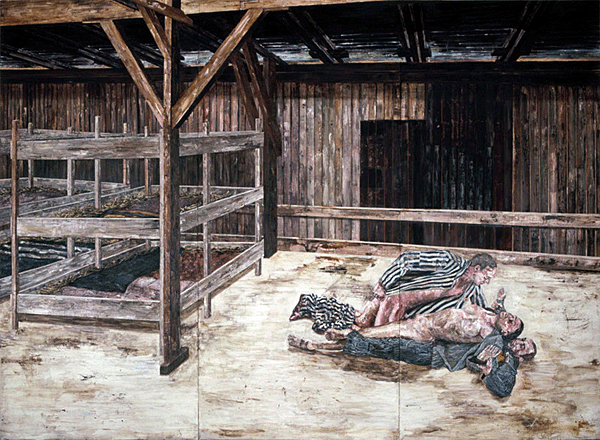
Execution, 1995 Oil on canvas 102.4 x 165.4
inches.
|
Visceral
Ophuis doesn't work within a defined moral code
because then the mind remains within a protected area and the impact of the
work dissapears. Dealing with violence and sexuality within art increases the
possibility of identification. Even when these fantasies are not present in
the viewer he will have a visceral reaction difficult to ignore. Besides this
a painting demands more time, when it affects you you will read it longer. By
adding a fysicality to the skin Ophuis hopes to accomplish a slowing down
process in the way we look.
|
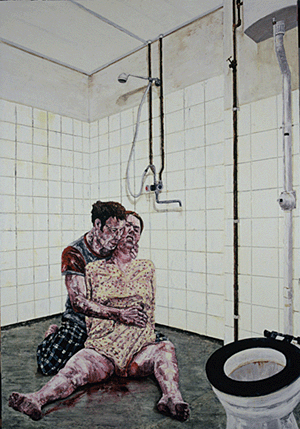
Miscarriage I, 1998
Oil on canvas 102.4 x 70.9
inches
|
Testimonials
>
Ronald Ophuis
paintings
are fictitious testimonials, dramatic events that have been staged in his
studio. The scenes are composed of actions that have been performed by the
actors in front of his camera. He takes dozens of pictures of the actors of
which the best serve as the basis for his life-size paintings. The actors
portray scenes like an execution, a miscarriage, a rape, a war scene...etc.
Before he stages this scenes he reads a lot
about the specific subject, seeks testimonials and photographic material or
moving images. He tries to visit and photograph the places for the setting he
has in mind for the painting and interviews witnesses. He also collects
specific clothing (or if necessary they are specially designed) for the actors
to wear.
Ophuis: "I often work 4 to 5 months on a
painting and there are days that you almost can't get through it, because it's
so penetrating. When I work on a canvas I often visualize the events inside my
head. The emotions that are evoked during this process give a lot of energy,
which are projected in the paintings. I think it is also very interesting to
find out exactly what those feelings are. I sometimes compare it with
Shakespeare, who occasionally was like a general who had people executed. It
is a studio-sensation, a feeling that you evoke by moving into the role of the
perpetrator".
Africa
Ophuis recently travelled to Sierra Leone to do
research for future projects. He has chosen Africa because he felt a growing
need to focus on some of the elements of the past wars. He says: "If you
assume that reality is incomprehensible and unmanageable and you need models
to catch 'sentiments' then that is what I am trying to achieve". Like
science works with models (economical, mathematical...etc.) visual arts also
uses models. He feels the need to look at these models in order to feel more
about a situation, to bring an event to life and to establish an affective
relation.
Recognition
Ronald Ophuis won several prestigious prizes
including the Artprize Province Overijssel in 1997, the Charlotte Köhlerprize
in 1998 and the Jeanne Oosting Prize for oil painting in 2004.