|
The
Poetic Ukiyo-e Genius Suzuki Harunobu.
Suzuki >
Harunobu
(1725?-1770) is often cited as one
of the great Ukiyo-e print artists, but the
magnitude of his reputation
as an artist is not matched by
the depth of information about the man himself. His
death date is one of the few certainties; he died in
1770, perhaps at the age of forty-five. He lived in
Edo
in the Yonezawa-cho district
near the Ryogoku Bridge, and he was probably a pupil
of Nishimura Shigenaga (1697?-1756) although it’s
hard to find any traces in Harunobu’s work that
might
indicate he was educated by
him. It is much more likely that he was influenced
by the Kyoto artist Nishikawa Sukenobu (1671-1751),
whose style is visible in Harunobu’s designs. Moreover,
Harunobu sometimes copied
complete designs by Sukenobu and the fact that his
death is recorded in the Nishikawa family record
suggests a teacher-pupil relationship.
Mitate-e.
Harunobu mainly worked in the
chuban format and is known for his fragile, sweet,
and elegant female figures. His women were from all classes: prostitutes, housewives, court ladies and
so forth, and were shown
performing all kinds of activities against
innovative backgrounds. They are often described as
ideal, dreamlike women. Harunobu is also famous for
his mitate-e (metaphorical
pictures) and he depicted the women of Edo by
placing them in modern interpretations of famous
scenes from classical stories and subjects.
|

|
| Snowman, c.1765, Harunobu. |
Bannermen.
Up until around 1765,
woodblock prints were coloured either by hand or
woodblock printed with a limited palette as seen in benizuri-e,
so called because of the dominant use of safflower
red (beni). Harunobu
too designed a number of benizuri-e. It was
also around this time, in 1764-65, that the samurai
bannermen (hatamoto) Okubo Jinshiro Tadanobu
(1722-1777) and fellow hatamoto Abe
Hachinojo Masahiro (d.1777) commisioned Harunobu to
design privately published prints for exchange
parties of egoyomi (pictorial calendar
prints) held at the New Year.
No expense seems to have
been spared in their production, and possibly with
the assistance of Harunobu’s neighbour, the
scholar and author Hiraga Gennai (1728-79), they
were printed using a full range of
colours. Full-colour printing, as spawned by these
privately issued egoyomi would soon be
adopted for commercially produced prints. These
commercial full-colour prints would become
known as nishiki-e, or ‘brocade pictures’,
so named because of their association with colourful
brocade silks (nishiki).
Chuban.
Harunobu
created a sizeable body of work in the last six
years of his life. Virtually all his non-erotic
prints were in the upright chuban format
(c.265 x 195 mm), whereas his numerous
erotic prints were horizontal chuban.
His most famous albums and series of chuban
prints are The Spell of Amorous Love (Enshoku koi
no urakata, c.1768-70; cat. no. 14); Eight
Fashionable Parlour Views (Furyu
zashiki hakkei, c.1768;
cat. no. 18); Eight Fashionable Views of Edo (Furyu
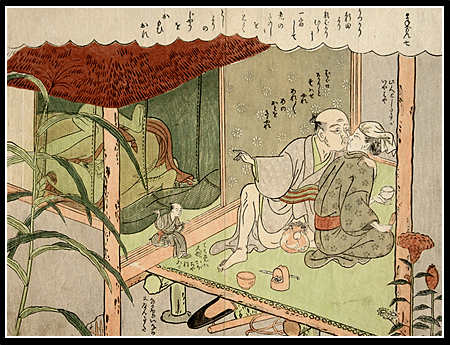
Edo Hakkei, c.1769; cat. no. 19); and The
Fashionable Lusty Maneemon
(Furyu enshoku Maneemon, 1770; cat. no. 22),
which consists of two albums of twelve prints (see
picture below!).
>
More
articles on Japansese woodblock prints
(erotica...etc.) can be found if you Click Here !
|