The Symbolism In Chinese Porcelain.
The Chinese culture has an enormous variety of
symbolic signs, each with a deeper meaning. The symbols always refer to
something positive and can not only be found on Chinese porcelain, but
also on their textiles, paintings, lacquered ware or jewelry.
The Chinese firmly believe that when you are
surrounded with good luck symbols your wishes come true. These symbols is what
a Westerner notices when he visits a Chinese restaurant which are still be
furnished according to this iconographic principle. From the lion statues at
the entrance, the dragon-shaped ornaments in the interior and the bat
decorations on the plates, it's all good luck symbolism.
|
|
Dragon
Of all these different good luck symbols the
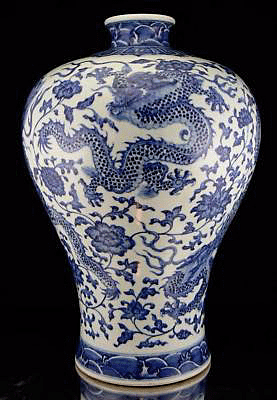
5-clawed dragon is the most important. This dragon was frequently depicted on
the porcelain of the Chinese emperor preferably in the lucky color red. Next
to its positive attributes it is also believed that the dragon has
supernatural powers and is also the most powerful of the Four Celestial
Animals. Together with the phoenix, that stands for the female principle
'yin', the dragon represents the male 'yang', forms an ideal combination. They
are especially a beloved motif at weddings.
|
A reproduced Qianlong (1736-1795) vase
of 12
1/2" tall with dragon
motifs.
|
Qilin
Just like the phoenix the qilin (a winged horse
with scale) is a mythical creature. When a young boy is depicted riding a
qilin it stands for a lot of male offspring which is very important in Chinese
culture. The fourth celestial animal is the turtle which symbolizes a long
life.
The symbols on Chinese porcelain that represent
happinesss, money, health, wisdom and immortality are different from how we
interpret them in the West. For instance, to us bats have a rather frightening
reputation but in Chinese the word 'Fu' means both 'bat' and 'happiness
and prosperity'.
Birds like the magpie which is supposed to
convey good luck; butterflies are a symbol of romance and eternal love;
fishes, since the Stone Age a symbol of abundance; and frogs represent
fertility. All can be found on Chinese porcelain and ceramics.
Elephant
The Chinese obsession for eternal life is
reflected in symbols like the peach, the calabash, the mushroom and the 'moon
hare'. For power and strength stands the lion and for strength and wisdom the
elephant. The Chinese name for elephant 'xiang' sounds the same as the
word for 'happiness and prosperity'. 'Sao xiang', which means 'washing
an elephant', sounds the same as the Buddhistic term 'finding true wisdom'.
Recent photos taken in Chinatown in New York
and in Amsterdam show that the traditional symbolism in modern society still
plays
a major role.
|
|
|
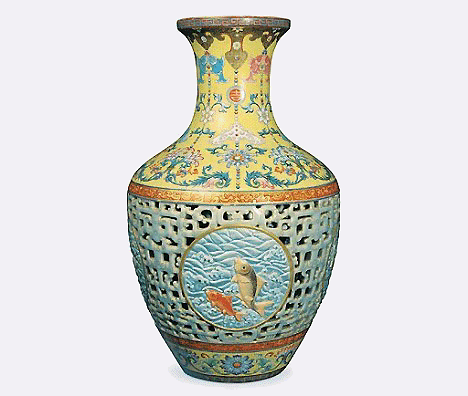
This 16" tall Qianlong porcelain vase
depicting two fishes, dating from around 1740 was
hammered down at the Bainbridge's auction house
for GBP 53.1 million (more than US$85M) while the estimate was between GBP
800,000 and GBP 1,200,000.
|
Check out the first picture on the following
page depicting >>
people washing an elephant
Click here for more
>>
articles on Asian art


