When he returns in Birmingham in 1979, he has a
mental breakdown when two of his nieces die during a fire, and he tries to end
his life.
When the attempt fails, he decides to deal with his sorrow by
creating something constructive and makes his first artwork of two tombstones
in memory of his deceased nieces. Holley also started his collection of yard
art. In 1981 he marries and gets three sons and two daughters.
|
|
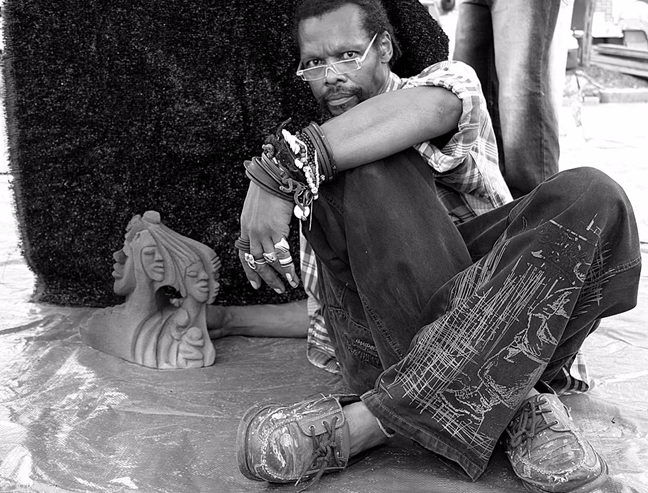
| Lonnie
Holley with one of his sandstone sculptures |
The remote piece of land where Lonnie Holley
and his family live is attainable by car via a bumpy and rising path until the
entrance is in sight. This is screened by old rags, blankets and quilts. By
simply raising a blanket you enter the grotesque, but overall inspired world
of Holley.
A world of which at first glance, seems to exist out of mere chaos,
but where, upon closer inspection and after one is accustomed, an
interdependence can be detected.
All kinds of objects of all different sizes,
made of the most divergent materials like scrap, industrial and household
wastes and found objects fill a piece of ground of 8000m². Also the trees are
part of the yard art. A stretched wire between the branches connects the trees
with bottles, tins, garments, painted pewter plates and old rags with
ideographic signs, that are attached to it. As a visitor you must make your
way between this incredible display of objects by which you come aware that
every seperate object is purposefully placed on that specific spot for a
reason.
|
|
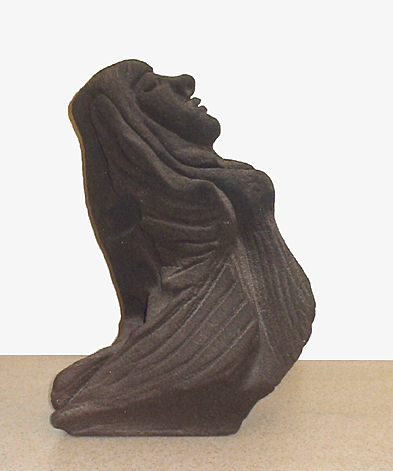
Woman
- Lonnie Holley ( born
February 10, 1950 )
Alabama Sand Stone |
Everywhere you look you see standing or lying
sandstone sculptures and masks (made of industrial waste from a nearby steel
factory, sometimes seperate, sometimes in groups. Fragments of this industrial
sandstone are still waiting to be processed; Lonnie Holley explains that this
is his way of expressing the elapsing of time, i.e.: what is, what was, what
will be. The sandstone sculptures are related stylistically to Mid and South
American and Egyptian sculptures, with which Holley was acquainted through
popular reading and television. He takes aspects from these civilisations,
because in his mythology ideas, he recognizes the meaning of the elapsing of
time in their creation of the pyramids.
The philosophy of his sculptures repeats itself
in his paintings and wire sculptures and in the whole idea of his yard.
Recurring themes in his work are the dream-mother representing the beginning
of all life, the acquiring of knowledge through an ancestral continuity and
the interaction between the material and the immaterial. "The earth is
made up of the dust of the ancestors". (Judith McWillie,' >
Lonnie
Holley's Moves', Art Forum, april 1992, p.80)
In the second part of this two part article
sequence we'll take a closer look on Holley's >
Yard Art
sculptures !