|
The Outsider Art of Thornton Dial ( Part 2 ) - William Arnett and Dial's
Work Environment.
> Thornton Dial's
encounter with > William Arnett
changed his life radically. A short while before, he
started a small company with his two sons where they build garden furniture of
wrought iron when Pullman Standard Company closed their doors. His son Richard
manufactured chairs and benches of wrought iron in which not the function was
the focus but the story, the allegorical meaning given to the specific piece
of furniture.
William Arnett's life started in Columbus, Georgia. With a college degree
in the English language and several additional art courses he started as a
salesman for an American company with European contacts. During his frequent
visits to Europe he utilized every opportunity to visit museums and cultural
institutions to increase his knowledge of European art and to broaden his
vision.
Then he decides to dedicate his life to
collecting art. He started his collection with Eastern Art, especially Chinese
porcelain and jade, Buddhistic and Hinduistic sculptures in bronze, stone and
wood. From the moment William Arnett came into touch with African art it was
love at first sight.
In the Seventies four important exhibitions held in the High Museum of Art in
Atlanta were compiled with objects from his collection.
In the Eighties Arnett starts collecting the work of black autodidacts from
the South of the U.S., because he finds the works have a great depth. Their
social meaning and underlying philosophy fascinate him. The artist Lonnie
Holley, who also lived in Alabama, made William Arnett attentive of
Thornton Dial by showing him a small object in the shape of a fishing bait
that was ingeniously and artistically designed by Dial. William Arnett
immediately was impressed by the quality of it. Since their first acquaintance
there has been a trust whereby William Arnett, Dial protects and stimulates
and has created an environment in which Dial undisturbedly can paint and work.
|
|
>
Sr.
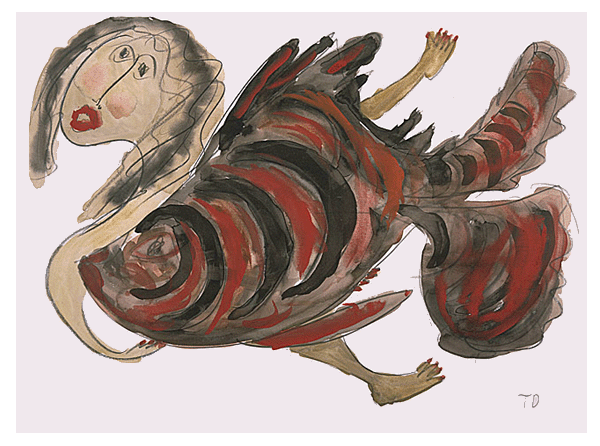
Title: Fishing for Business, 1991
watercolor and graphite on wove paper
Size: 22" x 30"
From the collection of Philadelphia Museum of Art
Picture by G. Wood
|
When visiting Thornton Dial the first thing that comes in sight is the
gravely house and the large piece of land surrounding it, where complete
silence reigns and nature seems to be completely untouched. The living
conditions in which Thornton Dial lives now are such, that he has a pond where
he fishes, his own piece of forest where he can keep his cows, chickens and
other cattle and his own comfortable work shed separate from the house.
Thornton Dial, in his eighties now, is a super slim and still vital
individual with an alert glance in his eyes. He sleeps and eats little, smokes
a lot and still works for many hours at a time in his studio. Although he is
full of energy he exudes peace and quiet. He does not speak much unless he is
asked a question. In spite of his limited vocabulary he expresses himself
clearly. The family tie is strong, Dial's married children and their families
are living with him.
In part 3, of this three part article sequence we'll focus on Thornton
Dial's works of art!
Here you can find part 1 of this three part article sequence: >
Thornton
Dial - The Beginning.
Here you can find part 2 of this three part article sequence: >
William
Arnett and Dial's Work Environment.
Here you can find part 3 of this three part
article sequence: >
The
Outsider Art of Thornton Dial ( Part 3 ) - His Outsider Folk Art.
|